- We track PPPN by destination market — Caribbean, Alaska, Mediterranean — not just by ticker.
- A single fleet-wide move can be entirely one region: Caribbean discounting while Alaska holds firm.
- Regional levels let you compare operators within a destination — RCL vs CCL in the Caribbean — heading into earnings.
- Cabin-level detail separates entry-level (interior) softness from premium (suite) strength within a region.
Why Region Matters
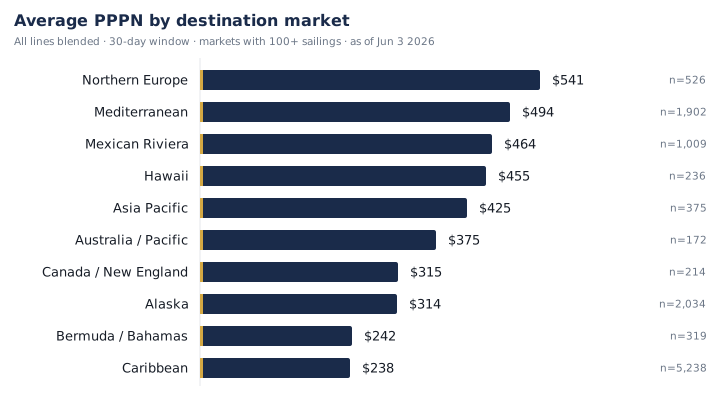
A fleet-wide pricing average answers how much an operator is pricing, but not where. Normalized to per-person-per-night (PPPN) and grouped by destination market, regional pricing answers the question the headline number can't: a fleet-wide drop might be entirely Caribbean discounting while Alaska holds firm—or the reverse.
Regions Tracked
Sailings are grouped by primary itinerary destination—not departure port. Eleven destination markets carry meaningful volume:
| Region | Example Itineraries |
|---|---|
| Caribbean | Eastern, Western & Southern Caribbean |
| Alaska | Inside Passage, Glacier routes |
| Mediterranean | Western Med, Greek Isles, Adriatic |
| Mexican Riviera | Cabo, Puerto Vallarta, Mazatlán |
| Northern Europe | Baltic, Norwegian Fjords, British Isles |
| Asia Pacific | Japan, Southeast Asia |
| Bermuda / Bahamas | Short cruises from the U.S. East Coast |
| Hawaii | Inter-island, Pacific Coast to Hawaii |
| Canada / New England | Coastal Canada, fall-foliage routes |
| Australia / Pacific | Australia, New Zealand, South Pacific |
| South America | Brazilian coast, Patagonia, Chilean fjords |
Beyond these, a long tail of low-volume markets (Atlantic Islands, Central America, Africa, Middle East) is tracked but rarely carries enough sailings to read.
Region is assigned by primary itinerary destination, not departure port. A cruise departing Miami to the Bahamas is classified as Bermuda / Bahamas, not Caribbean.
Reading Regional Price Levels
Each region carries an average PPPN that can be tracked over time and compared across operators. Two reads matter most:
- Level — how a destination prices in absolute PPPN terms (a premium Mediterranean itinerary sits far above a short Bahamas sailing).
- Trend — whether that level is firming or softening week over week and month over month, which is where demand shifts first show up.
A destination softening while the rest of an operator's fleet holds is a localized-demand read, not fleet-wide weakness—and that distinction matters for forecasting.
Comparing Operators Within a Region
Because pricing is normalized to PPPN, operators can be compared directly inside a single destination—the cleanest way to read relative positioning:
| Operator | Caribbean PPPN | Read |
|---|---|---|
| RCL | Higher / holding | Stronger Caribbean demand |
| CCL | Lower / easing | Discounting to fill |
| NCLH | Flat | Stable pricing |
Cabin-Level Detail
Within a region, PPPN can be split by cabin category to show which inventory is moving—the difference between entry-level softness and genuine premium pressure:
| Cabin moving | Interpretation |
|---|---|
| Interior easing | Clearing base capacity; entry-level demand soft |
| Premium (Balcony / Suite) easing | Pressure on higher-yield inventory—worth more attention |
| Interior firming | Base demand strengthening |
| Premium firming | Strong high-end demand; upsell opportunity |
"Interior easing" in Alaska reads as filling base inventory ahead of peak season. "Premium easing" would be a different—and more concerning—read.
Itinerary Mix Matters
The same regional move hits operators differently depending on exposure:
| Operator | Regional Exposure |
|---|---|
| RCL | ~40% Caribbean |
| CCL | More diversified |
| NCLH | Higher Alaska / Hawaii mix |
A Caribbean-heavy softening impacts RCL more than CCL given exposure. Regional pricing combined with itinerary-mix data enables more precise revenue-impact reads.
A fleet average tells you how much an operator is pricing. Regional pricing tells you where the demand is.
Time Windows
| Window | Best For |
|---|---|
| 7 days | Catching fresh promotional activity or a demand response |
| 30 days | Smoothing weekly noise, tracking monthly trend |
| QTD | Aligning with earnings periods, quarter-over-quarter comparison |
Shorter windows surface shifts faster but carry more noise; longer windows give cleaner trends but lag real-time activity.
Data Freshness
Every tracked sailing is priced once a day across the full fleet, and regional aggregates refresh from that same data—so a regional read reflects current market conditions rather than a stale snapshot.